

Seminars
Fall 2026 AOES Seminars
2 Sep (CLIM) - Lee, Precipitation in SPEAR model

Speaker: Jaeyeon Lee, George Mason University
Title: Resolution Dependence of Extratropical Cyclone Precipitation over the United States in the GFDL SPEAR model
Time: Wednesday, September 2, 2026, 1:30–2:30 pm
Location: Exploratory Hall Room L111 or via Zoom (for Zoom link, email xdu5@gmu.edu)
Abstract: Extratropical cyclones produce most of the cold-season precipitation over the contiguous United States, and their representation in climate models is sensitive to horizontal resolution. Increasing resolution is known to increase simulated mean precipitation across many models, but it remains unclear whether this increase is cyclone-related and, if so, which cyclone properties it reflects. In this talk I address that question using the GFDL SPEAR model hierarchy, whose three atmospheric resolutions of 100, 50, and 25 km share the same physical parameterizations and ocean model. Its growing wet bias over the West Coast and the eastern United States turns out to be carried entirely by cyclone-related precipitation, and to arise from precipitation intensity rather than from how often or how widely cyclones rain. Conditioning each cyclone on the moisture flux it encounters shows that higher-resolution cyclones rain more intensely at the same flux, but that this response takes different forms in the two regions: over the eastern United States the sensitivity of precipitation to moisture flux increases with resolution, whereas over the West Coast the precipitation increment remains nearly constant across moisture-flux conditions. I close by examining what these contrasting responses imply for interpreting a resolution-driven change in regional-mean precipitation.
Bio:Jaeyeon Lee is a postdoctoral research fellow in the Department of Atmospheric, Oceanic, and Earth Sciences at George Mason University, working with Cristiana Stan. He received his Ph.D. from Seoul National University in 2023 and was previously a postdoctoral researcher at Princeton University and NOAA/GFDL. His research examines how midlatitude weather systems shape regional climate and hydroclimate extremes, with a particular focus on extratropical cyclones and storm tracks, their interactions with the large-scale circulation, and their representation in climate models.
3 Sep (GEOL) - Sanders, Title TBD
Speaker: Cecelia Sanders
Title: TBD
Time:Thu, 3 Sep, 4:30pm ET
Location:Exploratory 1309 and via Zoom (for link, email ggilleau@gmu.edu)
Host: Geoffrey J Gilleaudeau
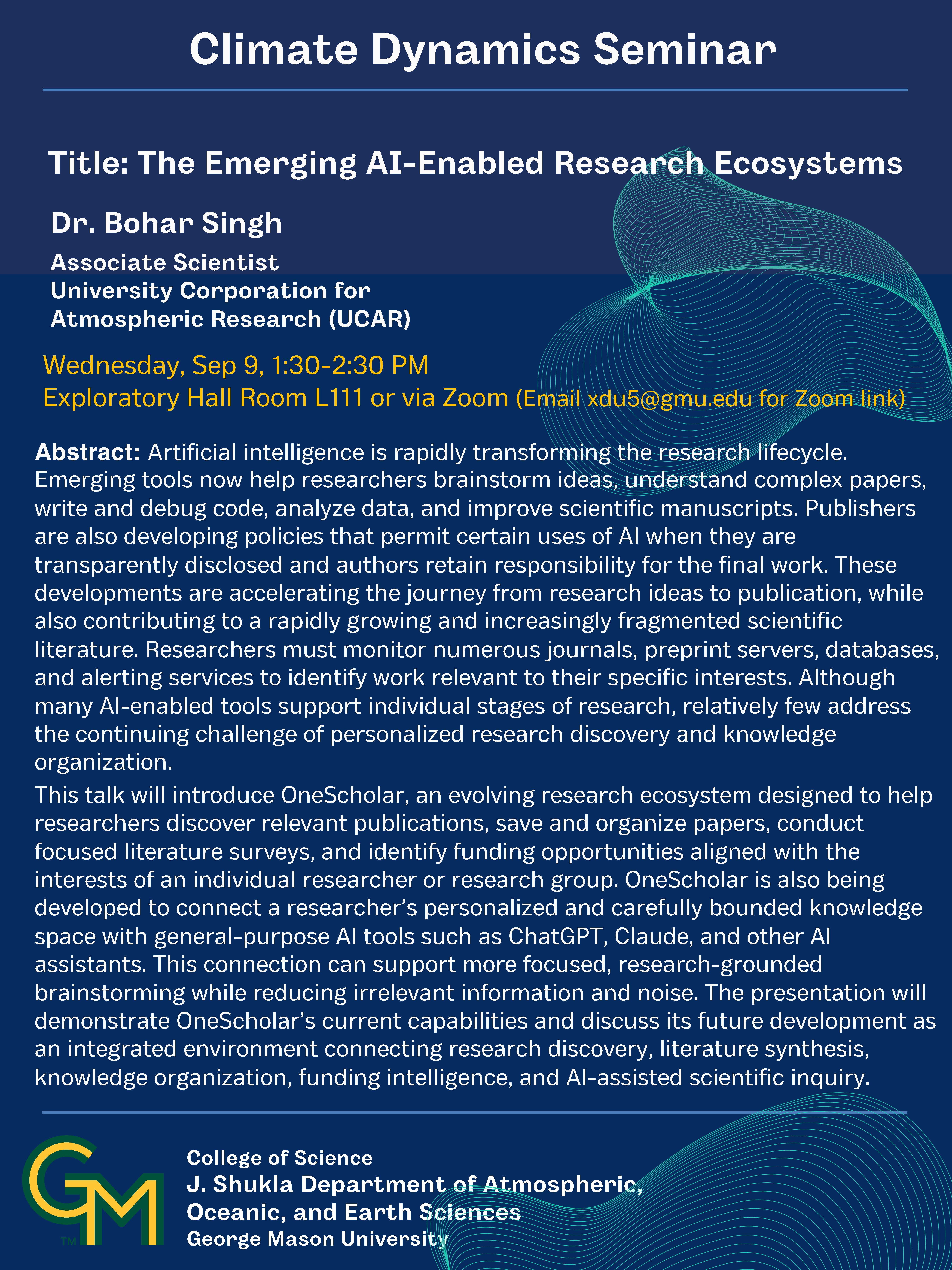
9 Sep (CLIM) - Singh, Emerging AI-Enabled Research Ecosystems
Speaker: Bohar Singh, UCAR
Title: The Emerging AI-Enabled Research Ecosystems
Time: Wednesday, September 9, 2026, 1:30–2:30 pm
Location: Exploratory Hall Room L111 or via Zoom (for Zoom link, email xdu5@gmu.edu)
Host: Xiaojing Du
ABSTRACT: Abstract: Artificial intelligence is rapidly transforming the research lifecycle. Emerging tools now help researchers brainstorm ideas, understand complex papers, write and debug code, analyze data, and improve scientific manuscripts. Publishers are also developing policies that permit certain uses of AI when they are transparently disclosed and authors retain responsibility for the final work. These developments are accelerating the journey from research ideas to publication, while also contributing to a rapidly growing and increasingly fragmented scientific literature. Researchers must monitor numerous journals, preprint servers, databases, and alerting services to identify work relevant to their specific interests. Although many AI-enabled tools support individual stages of research, relatively few address the continuing challenge of personalized research discovery and knowledge organization.
This talk will introduce OneScholar, an evolving research ecosystem designed to help researchers discover relevant publications, save and organize papers, conduct focused literature surveys, and identify funding opportunities aligned with the interests of an individual researcher or research group. OneScholar is also being developed to connect a researcher’s personalized and carefully bounded knowledge space with general-purpose AI tools such as ChatGPT, Claude, and other AI assistants. This connection can support more focused, research-grounded brainstorming while reducing irrelevant information and noise. The presentation will demonstrate OneScholar’s current capabilities and discuss its future development as an integrated environment connecting research discovery, literature synthesis, knowledge organization, funding intelligence, and AI-assisted scientific inquiry.
10 Sep (GEOL) - Ahm, TitleTBD
Speaker: Anne-Sofie Ahm
Title: TBD
Time:Thu, 10 Sep, 4:30pm ET
Location:Exploratory 1309 and via Zoom (for link, email ggilleau@gmu.edu)
Host: Geoffrey J Gilleaudeau
16 Sep (CLIM) - Tang, CONUS High-Resolution NO₂ Dataset

Speaker: Beiming Tang
Title:Developing a Long-Term, High-Resolution Surface NO₂ Dataset over the CONUS Using Machine Learning Data Fusion
Time: Wed, 16 Sep, 1:30-2:30 pm
Location: Exploratory Hall, Room L011 or via Zoom (for Zoom link, email xdu5@gmu.edu)
ABSTRACT: Nitrogen dioxide (NO₂) is an important air pollutant and a key precursor of ozone (O₃) and fine particulate matter (PM2.5). However, existing surface NO₂ datasets often have limited ability to resolve urban-scale spatial variability. Leveraging the George Mason University North America Chemical Reanalysis (NACR) project and Neighborhood Emission Mapping Operation (NEMO), we developed a machine learning data fusion framework that integrates satellite observations, chemical transport model simulations, high-resolution emissions, meteorology, and land-surface information. Sensitivity analyses were conducted to identify suitable predictor combinations and extend the framework to years when high-resolution TROPOMI and NEMO data were unavailable. The resulting dataset provides daily surface NO₂ concentrations at 1 km resolution across CONUS from 2002 to 2020. Ten-fold cross-validation against EPA Air Quality System observations yielded correlations of approximately 0.97 and RMSEs of 1.68–1.96 ppb. The dataset captures urban-scale features such as elevated NO₂ along major highways and in downtown areas, providing a valuable resource for air quality, exposure, and epidemiological studies.
Bio: Dr. Beiming Tang is a Postdoctoral Research Fellow in Dr. Daniel Tong’s group at George Mason University, jointly affiliated with NOAA’s Air Resources Laboratory. His research integrates machine learning, chemical transport modeling, and observations to improve air quality simulation, forecasting, and high-resolution characterization of atmospheric pollutants. Dr. Tang has developed high-resolution air quality datasets and has contributed to major atmospheric field campaigns. He is also a developer of the DAFCOM next-generation air quality forecasting system and the community model evaluation tool MELODIES-MONET.
17 Sep (GEOL) - Evans, Outback to the Yukon
Speaker: Scott Evans
Title: From the Outback to the Yukon: New data on the oldest animals of the Ediacaran
Time:Thu, 17 Sep, 4:30pm ET
Location:Exploratory 1309 and via Zoom (for link, email ggilleau@gmu.edu)
Host: Geoffrey J Gilleaudeau
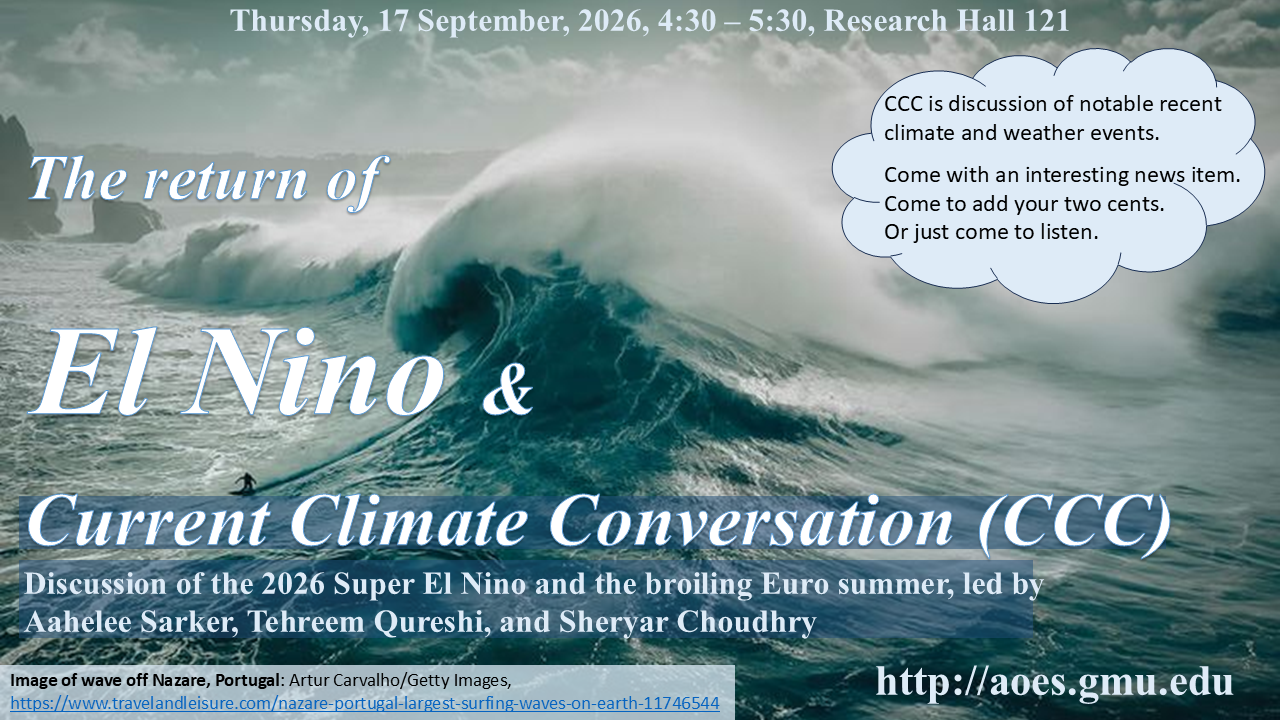
17 Sep (CLIM) - Current Climate Conversation
Speaker: Aahelee Sarker, Tehreem Qureshi, Sheryar Choudhry
Title:Current Climate Conversation
Time:Thu, 17 Sep, 4:30 – 5:30 pm, Research Hall 121
23 Sep (CLIM) - McKinnon, Physics & Statistics of extreme heat

Speaker: Dr. Karen McKinnon, UCLA/ Johns Hopkins University
Title: The physics and statistics of extreme heat: land-atmosphere interactions and shifting distributions
Time: Wed, 23 Sep, 1:30-2:30 pm
Location: Exploratory Hall Room L111 or via Zoom (for Zoom link, email xdu5@gmu.edu)
Host: Aahelee Sarker
ABSTRACT: Heat extremes result from the convergence of atmospheric and land processes across multiple spatial and temporal scales. While we can be quite confident that heat extremes will become more frequent in a warming world, major uncertainties remain in terms of how and why they will change. Despite many recent high-impact heat waves, observations and climate models agree that the hottest summer temperatures have warmed at approximately the same pace as the median. Consistent with this result, much of the spatial pattern of changes in heatwave frequency, duration, and intensity can be explained by a shift in the mean temperature distribution, with climatological variance and skewness determining how warming translates into changes in different heatwave metrics. The relative changes in the median and tails are well-predicted by two components of the surface energy budget, the evaporative fraction and net surface radiation. While it has generally been thought that the evaporative fraction would decrease with warming, and therefore amplify heat extremes, we show that regions and days with strong land-atmosphere coupling tend to have smaller soil moisture reductions, thereby limiting the role of land surface changes in amplifying temperature extremes.
Bio: Karen McKinnon is a professor of Statistics and the Environment at the University of California, Los Angeles. Beginning in November 2026, she will join the Department of Environmental Health at Johns Hopkins University. Her research sits at the nexus of climate change and statistics, and is aimed at improving our understanding and prediction of climate extremes, variability, and change. She is a 2027 AMS Henry G. Houghton Awardee, a 2024 NSF CAREER awardee, a 2023 Kavli Fellow, and a 2021 Packard Fellow in Science and Engineering.
24 Sep (GEOL) - Standring, Foraminifera Test Morphology & Environment
Speaker: Patricia Standring
Title: Does foraminifera test morphology record environmental variability? A case study from the Messinian Salinity Crisis in the western Mediterranean Sea
Time:Thu, 24 Sep, 4:30pm ET
Location:Exploratory 1309 and via Zoom (for link, email ggilleau@gmu.edu)
Host: Geoffrey J Gilleaudeau
30 Sep (CLIM) - Tallapragada, NWP at NOAA NWS

Speaker: Dr. Vijay Tallapragada, NOAA NWS Office of Modeling and Development
Title:Operational Modeling Advancements in NOAA: Progress and Challenges
Time: Wed, 30 Sep, 1:30-2:30 pm
Location: Exploratory Hall, Room L111 or via Zoom (for Zoom link, email xdu5@gmu.edu)
Host: Jim Kinter
ABSTRACT: NOAA, in close collaboration with the broader community, is rapidly advancing a fully coupled Earth system modeling capability through the Unified Forecast System (UFS). As a community-based modeling framework, the UFS is designed to unify research and operations across a broad range of temporal and spatial scales. By replacing a collection of disparate legacy models with a unified modeling system, it supports applications spanning sub-hourly, convection-allowing local forecasts to subseasonal and seasonal global predictions, serving as the cornerstone of NOAA's strategy for next-generation environmental prediction.
In addition, Artificial Intelligence and Machine Learning (AI/ML) technology have advanced rapidly in recent years, transforming the field of numerical weather prediction with improved forecast skill and remarkable efficiency. In response, operational centers are beginning to integrate AI/ML models into their systems to provide transformative forecast products. Three distinct global AI applications (AIGFS, AIGEFS and HGEFS) have already been implemented into operations - these are NOAA's AI-based emulators of the Global Forecast System (GFS) and Global Ensemble Forecast System (GEFS), and HGEFS essentially combines physical and AI ensembles to generate a larger ensemble.
Thanks to the Administration’s renewed priority for global leadership in NWP, NOAA has embarked on a new Modeling Moonshot initiative (also known as modeling grand challenge). This is aimed at modernizing the operational modeling suite through a transformation to advanced software and cloud-based HPC architectures, expansion of hybrid data-driven (AI) & physics-based ensemble prediction systems, and the adoption of the Model for Prediction Across Scales (MPAS) for a global, coupled, km-scale ensemble system driven by a continuously-operating data assimilation (DA) system.
This presentation provides an update on several key UFS applications that are in advanced stages of development and are being prepared for operational implementation within the National Weather Service (NWS), along with AI based applications and the Moonshot Initiatives that are rapidly advancing.
1 Oct (GEOL) - Gilleaudeau, American Geologist's Australian Adventure
Speaker: Geoff Gilleaudeau
Title: Crikey! An American geologist’s adventure in Australia
Time:Thu, 1 Oct, 4:30pm ET
Location:Exploratory 1309 and via Zoom (for link, email ggilleau@gmu.edu)
Host: Geoff Gilleaudeau
7 Oct (CLIM) - Nedza, UFS Tropical Cyclones

Speaker: Dr. Douglas Nedza, George Mason University
Title: Evaluating Seasonal Forecasts of Tropical Cyclone Activity using Experimental UFS Prototypes
Time: Wed, 7 Oct, 1:30-2:30 pm
Location: Exploratory Hall, Room L111 or via Zoom (for Zoom link, email xdu5@gmu.edu)
ABSTRACT: Many agencies issue seasonal outlooks of tropical cyclone (TC) activity informing planning activities. NOAA is in the process of developing a next-generation dynamical forecast system, the Unified Forecast System (UFS). As part of this development process, ensembles of reforecasts are produced using the experimental prototypes of UFS to serve as a test-bed to evaluate seasonal forecast skill. Here, we evaluate UFS prototypes Beta1.0, P8, and HR3, in forecasting western North Pacific (WNP) and North Atlantic (NA) seasonal TC activity in April and May initialized reforecasts. Reforecast TC events are identified using the TempestExtremes event tracking algorithm based on characteristic features of TCs, such as local sea level pressure, temperature, and winds. Dynamical forecasts of seasonal TC event numbers and accumulated cyclone energy (ACE) are produced by aggregating the identified TC events. Reforecast variations of TC activity are generally skillful over the reforecast period, although correlations values depend on the TC identification criterion, oceanic basin, and forecasted TC metric. Biases in seasonal TC activity are assessed and related to biases in the large-scale environment for each basin.
8 Oct (GEOL) - Peters, Cycling of the sedimentary rock reservoir
Speaker: Shanan Peters
Title: Cycling of the sedimentary rock reservoir: Implications for the Earth-life system
Time:Thu, 8 Oct, 4:30pm ET
Location:Exploratory 1309 and via Zoom (for link, email ggilleau@gmu.edu)
Host: Geoffrey J Gilleaudeau
15 Oct (GEOL) - Denniston, Australian savanna bushfire collapse
Speaker: Rhawn Denniston
Title: Stalagmites reveal post-colonial collapse of high-temperature bushfire in Australian tropical savanna
Time:Thu, 15 Oct, 4:30pm ET
Location:Exploratory 1309 and via Zoom (for link, email ggilleau@gmu.edu)
Host: Geoffrey J Gilleaudeau
19 Oct (CLIM & GEOL) – Lam [Postponed to Spring Semester]
Speaker: Joint Climate–Geology seminar: Adriane Lam
Title:Postponed to Spring Semester
Time: Mon, 19 Oct, 4:00-5:00 pm
Location: Exploratory Hall, Room L111 or via Zoom (for Zoom link, email xdu5@gmu.edu)
Host: TBD
ABSTRACT: TBD
21 Oct (CLIM) - Hu, Circulation Shift ITCZ Migration

Speaker: Dr. Aixue Hu, National Center for Atmospheric Research (NSF NCAR)
Title:Migration of the Intertropical Convergence Zone Driven by Ocean Circulation Changes
Time: Wed, 21 Oct, 1:30-2:30 pm
Location: Exploratory Hall, Room L111 or via Zoom (for Zoom link, email xdu5@gmu.edu)
Host: Go Sato/Xiaojing Du
ABSTRACT: The Intertropical Convergence Zone (ITCZ) is essential to global precipitation patterns and has major socioeconomic and environmental impacts. Yet its future position remains uncertain. Here, using reanalysis data, Earth system model simulations, and targeted sensitivity experiments, we assess risks of the ITCZ crossing any thresholds and find only about one-third of CMIP6 models with a more northern ITCZ mean position-closer to the observed climatological state-simulate a southward ITCZ shift consistent with recent observations. This shift requires a substantial weakening of the Atlantic Meridional Overturning Circulation (AMOC), while the warmer base state alone is insufficient to push it farther north. Furthermore, a collapsed AMOC pushes the ITCZ into the Southern Hemisphere without a warmer base state, and toward the equator when combined with a warmer base state—both cases leading to significant changes in global rainfall patterns. These findings imply that the observed southward ITCZ migration over recent decades is consistent with a weakened AMOC, within the context of coupled atmosphere-ocean interactions.
22 Oct (GEOL) - Jenkins, Sensing in a strange land
Speaker: Kelsey Jenkins
Title: Sensing in a strange land: The early evolution of reptiles and their senses
Time:Thu, 22 Oct, 4:30pm ET
Location:Exploratory 1309 and via Zoom (for link, email ggilleau@gmu.edu)
Host: Geoffrey J Gilleaudeau
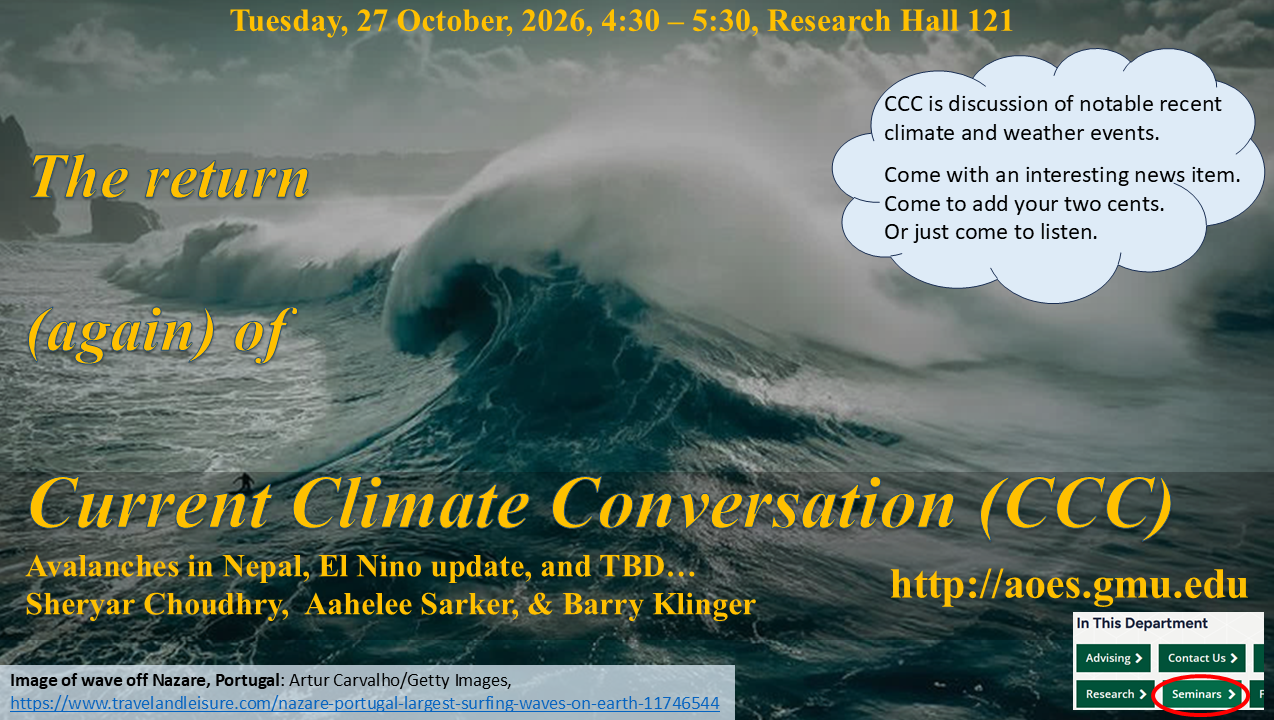
27 Oct (CLIM) - Current Climate Conversation
Speaker: Aahelee Sarker, Sheryar Choudhry, and Barry Klinger
Title:Current Climate Conversation
Time:Tue, 27 Oct, 4:30 – 5:30 pm, Research Hall 121
28 Oct (CLIM) - Thompson, Modernizing US Precipitation Modeling

Speaker: Dr. Alexander Thompson, University of Colorado Boulder’s Cooperative Institute for Research in Environmental Sciences (CIRES)
Title:Modernizing extreme precipitation guidance for the United States with kilometer-scale modeling
Time: Wed, 28 Oct, 1:30-2:30 pm
Location: Exploratory Hall, Room L111 or via Zoom (for Zoom link, email xdu5@gmu.edu)
Host: Tehreem Qureshi/Xiaojing Du
ABSTRACT: Probable maximum precipitation (PMP) is an important design standard for ensuring the safety of our nation’s aging critical infrastructure in the face of more frequent precipitation extremes. A 2024 National Academies of Sciences, Engineering, and Medicine (NASEM) report on modernizing probable maximum precipitation for the United States recommends creation of a multi-model large ensemble of kilometer-scale climate simulations for improved estimation of this outdated design standard. In this talk, I will first introduce an ongoing effort within NOAA’s Physical Sciences Laboratory to modernize PMP following NASEM report recommendations. Next, I will present a large ensemble of kilometer-scale climate simulations, called CONUS-Futures, that aims to address long-term recommendations from the NASEM report for estimating PMP into the future. This dynamically downscaled model ensemble uses the Weather Research and Forecasting (WRF) model to downscale global climate models, such as NCAR’s CESM2 Large Ensemble, over a conterminous United States (CONUS) domain. The first iteration of CONUS-Futures began production mode in July 2026 on Microsoft Azure’s cloud computing system and is estimated to be complete in March 2027.
Bio: Dr. Alex Thompson is a Research Scientist II at the University of Colorado Boulder’s Cooperative Institute for Research in Environmental Sciences (CIRES) and an affiliate in NOAA’s Physical Sciences Laboratory. His research explores extreme precipitation in kilometer-scale models as a part of NOAA’s Probable Maximum Precipitation Modernization effort. Alex completed his PhD at the University of Michigan in 2021 and served as a Postdoc at Washington University in St. Louis from 2021-2024.
29 Oct (GEOL) - Wilson, Capturing geology digitally
Speaker: Frederic (Ric) H Wilson
Title: Capturing geology digitally: An example from Alaska and the Caribbean
Time:Thu, 29 Oct, 4:30pm ET
Location:Exploratory 1309 and via Zoom (for link, email ggilleau@gmu.edu)
Host: Geoffrey J Gilleaudeau
2 Nov (GEOL) - Burgess, Dissertation Defense
Speaker: PhD student - Allison Burgess, GMU Chemistry & Biochemistry PhD Program
Defense title: Development of Trace Element-Based Paleoproxies in Estuarine Benthic Foraminifera Native to the Chesapeake Bay for Environmental Reconstructions of Salinity and Dissolved Oxygen
Time: Monday, Nov 2, 2026, 12:00 pm ET
Location: Exploratory Hall 3301 and via Zoom (for link, email ggilleau@gmu.edu)
Faculty advisor: Dr. Brittany Hupp
Abstract: The trace element geochemistry (TE/Ca) of foraminiferal microfossils has been instrumental in reconstructing past ocean conditions; however, limited work has investigated the TE/Ca geochemistry of estuarine species. Estuaries are dynamic marginal marine environments with ecological, economic, and cultural significance and are experiencing rapid environmental change due to anthropogenic and climate change stressors. Yet tools to understand changes in these systems beyond observational records are lacking. This dissertation develops new and evaluates existing TE/Ca-based paleosalinity and paleoredox proxies in estuarine benthic foraminifera native to the Chesapeake Bay. Chapter 1 examines the underlying water chemistry of a freshwater to marine salinity gradient and seasonal dissolved oxygen gradient in the Potomac River and Chesapeake Bay. Chapters 2 and 3 examine foraminiferal TE/Ca geochemistry along these same natural gradients, resulting in the development of a new paleosalinity proxy for use in reconstructing rates of saltwater incursion into estuaries.
4 Nov (CLIM) - Straus, Storm Tracks

Speaker: Dr. David Straus, George Mason University
Title:Upper-Level Storm Tracks
Time: Wed, 4 Nov, 1:30-2:30 pm
Location: Exploratory Hall, Room L111 or via Zoom (for Zoom link, email xdu5@gmu.edu)
ABSTRACT: Northern Hemisphere storm tracks refer to the collective behavior of extra-tropical cyclones and anti-cyclones. They have been the subject of an enormous amount of research and interest for nearly 100 years. Traditionally, two storm tracks have been considered as separate entities, one over the Pacific Ocean and the other over the Atlantic. But research over the past few decades has shown that they are coupled through wave propagation in the upper troposphere. Perhaps there is only a single storm track whose character varies along its extent?
In this talk, the important role of the meridional flux of zonal momentum in defining the anatomy of the upper-level storm track is emphasized. The importance of the zonal average of the momentum flux is well-known, yet its longitudinal structure has not been discussed nearly as extensively. It helps to define the shape of the eddies, exerts some surprising control on extreme precipitation, and couples the traditionally considered oceanic storm tracks. Evidence for the latter in recent research of the author is presented and interpreted through the concept of Rossby wave packets. The talk is meant to be accessible to our graduate students.
Bio: Dr. Straus earned his B.A. in Physics, summa cum laude, from the University of Pennsylvania in 1970 and his Ph.D. in Physics from Cornell University in 1977. He began his career in atmospheric science as a postdoctoral researcher at MIT with Jule Charney, where he developed a lasting interest in climate dynamics. He subsequently worked at COLA and GMU, with J. Shukla serving as a longtime mentor. His research interests span theoretical fluid dynamics, atmospheric predictability, and large-scale circulation patterns associated with extreme weather.
5 Nov (GEOL) - Johnson, Permian Loess and Glaciation
Speaker: Lilly Pfeifer-Johnson
Title: Permian loess and equatorial glaciation in eastern equatorial Pangea: Perspectives on the late Paleozoic climate system from sedimentary basins in southern France
Time:Thu, 5 Nov, 4:30pm ET
Location:Exploratory 1309 and via Zoom (for link, email ggilleau@gmu.edu)
Host: Geoffrey J Gilleaudeau
11 Nov (CLIM) - Wang, Advancing Wildfire Research with LES & ML

Speaker: Dr. Siyuan Wang, University of Miami
Title:Advancing Wildfire Research using High Resolution, Turbulence-Resolving Large Eddy Simulation (LES) and Machine Learning
Time: Wed, 11 Nov, 1:30-2:30 pm
Location: Exploratory Hall, Room L111 or via Zoom (for Zoom link, email xdu5@gmu.edu)
Host: Daniel Tong
ABSTRACT: Wildfires affect weather and climate, with costly impacts on human health and properties. With record high heat and severe drought conditions in the western United States, wildfires have become a growing concern. Despite decades of research, wildfires are still challenging to represent in modern air quality models. One fundamental reason is that the spatial resolutions at which air quality models are operated are much coarser than the spatial extent of most wildfires. As a result, several key processes in wildfires cannot be explicitly resolved especially in the early stage. Methods available to parameterize these subgrid-scale processes remain highly uncertain and have major impacts on the plume transport and the impacts on air quality downwind. In this presentation, I seek to address some of these issues faced by large scale air quality models. An idealized Large Eddy Simulation (LES) model, coupled with simple yet representative chemistry, is used to study the turbulence-chemistry interactions in fresh wildfire plumes, with implications for air quality models with coarser grid resolutions. I also present the development of a new wildfire plume rise scheme, based on the idealized LES model. A machine learning framework, trained by this LES model, emulates the plume rise process considering the impacts of the fire-induced buoyancy, entrainment, and moisture processes (microphysics). Preliminary results show that this LES-trained machine learning emulator outperforms the benchmark model, a widely used physics-based plume rise model in terms of mean smoke injection height and smoke profile shape. In the end, I'll also very briefly discuss how we use ambient observations to advance wildfire research, including satellite observations as well as weather radar (NEXRAD).
Bio: Dr. Siyuan Wang is an associate professor in the Department of Atmospheric Sciences at the Rosenstiel School at the University of Miami. Prior to joining Miami, Dr. Wang was a research scientist at the Cooperative Institute for Research In Environmental Sciences (CIRES) working at the National Oceanic and Atmospheric Administration (NOAA)/Chemical Sciences Laboratory. Dr. Wang uses a wide variety of observations and modeling tools to study physical and chemical processes in the atmosphere. Dr. Wang received his PhD from the Hong Kong University of Science and Technology.
11 Nov (CLIM) – Stempkovski, Thesis Defense, Extreme Heat and Power Outages
Speaker: Ivy Stempkovski, Climate Dynamics Program
Title:MS Thesis Defense: Linking Extreme Heat Weather Types to Power Outage Risk in the Northeast US
Time: Wed, 11 Nov, 3:45 pm
Location: Exploratory Hall, Room 3301 or via Zoom (for Zoom link, email lortizur@gmu.edu)
Thesis Advisor: Luis Ortiz
ABSTRACT: Reliable electricity is essential to societal function, from household appliances to public infrastructure and beyond. Air conditioning, for instance, is a critical safeguard especially under extreme heat conditions. However, extreme heat severely reduces the capacity of the electrical grid. Decreased grid function coupled with increased demand-side stress due to cooling needs can quickly lead to power outages. Ultimately caused by a supply-demand mismatch, extreme heat related power outages exacerbate morality risk by eliminating access to essential services such as air conditioning.
While component-level stress and health impacts are well characterized, extreme heat in the context of power outages remains understudied. Existing work primarily focuses on operational optimization under heat stress rather than the intersection of outages and climate dynamics that leads to those events.
To address this gap, we propose a geographically scalable framework to understand the meteorological drivers of extreme heat related power outages and the spatial distribution of associated risk by NOAA NCEI CONUS Climatological region. We present a Northeast US test case in which county-level power outage risk is assessed through synoptic extreme heat weather types. The Weather Types (WTs) are first established by k-means clustering of upper air circulation anomalies (z500; u,v900) then further characterized through forcing mechanisms (t850, u850, v850, w800) and surface conditions (t2m, Q2m) using 40 years (1982-2022) of ERA5 data. We then explore the meteorological drivers of power outage risk at the county, Independent System Operator (ISO), and regional level through WT co-occurrence frequency using 8 years (2015-2022) of county-level EAGLE-I power outage data.
Analyzing extreme heat WTs by region resolves multi-scale drivers and spatiotemporal heterogeneities often smoothed over in existing work. We find that high intensity (t2m, Q2m) and long duration extreme heat events with a large spatial extent and early season dominance contribute the most to extreme heat power outage risk in the Northeast. The highest risk ISO is the Pennsylvania, New Jersey, Maryland (PJM) Interconnection. The highest risk counties are Bucks County (PA), Montgomery County (PA), Sussex County (NJ), Morris County (NJ), and Orange County (NY). This work provides critical insights for building grid resiliency as the aging, outdated infrastructure becomes increasingly ill-equipped to face modern challenges.
12 Nov (GEOL) - Bowyer, Cambrian Stage 2 Boundary
Speaker: Fred Bowyer
Title: Global controls on the stratigraphic expression of the Cambrian Stage 2 lower boundary
Time:Thu, 12 Nov, 4:30pm ET
Location:Exploratory 1309 and via Zoom (for link, email ggilleau@gmu.edu)
Host: Geoffrey J Gilleaudeau
18 Nov (CLIM) - Newman, Title TBD
Speaker: Matthew Newman
Title:TBD
Time: Wed, 18 Nov, 1:30-2:30 pm
Location: Exploratory Hall, Room L011 or via Zoom (for Zoom link, email xdu5@gmu.edu)
Host: Aahelee Sarker
ABSTRACT: TBD
19 Nov (GEOL) - Asmerom, Warming and Neotropical Paleoclimate
Speaker: Yemane Asmerom
Title: Insights into the ITCZ response to warming from Neotropical paleoclimate data
Time:Thu, 19 Nov, 4:30pm ET
Location:Exploratory 1309 and via Zoom (for link, email ggilleau@gmu.edu)
Host: Geoffrey J Gilleaudeau
2 Dec (CLIM) - Tomoff, Meteorologist at Mars Wrigley
Speaker: Alex Tomoff
Title:Lead Meteorologist at Mars Wrigley
Time: Wed, 2 Dec, 1:30-2:30 pm
Location: Exploratory Hall, Room L011 or via Zoom (for Zoom link, email xdu5@gmu.edu)
Host: Ivy Stempkovski
ABSTRACT: TBD
3 Dec (GEOL) - Graduate Students, Research Presentations
Speaker: Graduate Students
Title: Various short research presentations from geology graduate students
Time:Thu, 3 Dec, 4:30pm ET
Location:Exploratory 1309 and via Zoom (for link, email ggilleau@gmu.edu)
Host: Geoffrey J Gilleaudeau