

On the Blade’s Edge of Physics: How George Mason's Ilia Malinin Lands the Quad Lutz
What is the physics of a quad lutz? Physics and Astronomy Professor Ferah Munshi explains.
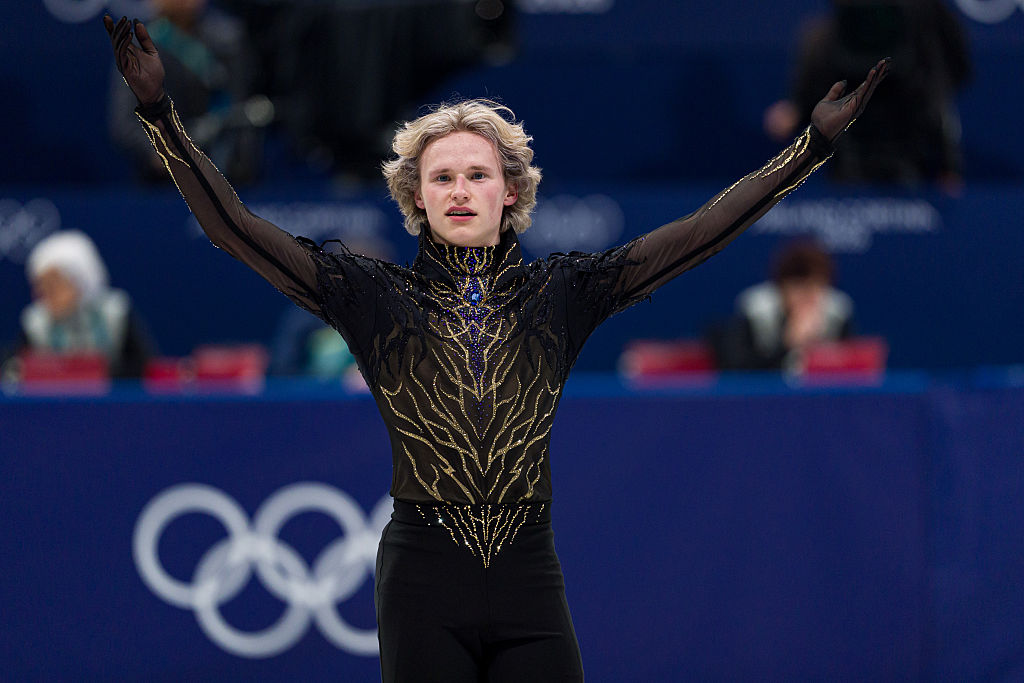
This is a quad Lutz. Four full rotations. A backward takeoff. From a single skate edge. From a physics perspective, this jump barely works. And the first person to land it consistently is Ilia Malinin, a George Mason University student. When I first watched Ilia perform this jump, my first reaction wasn’t disbelief. It was awed curiosity. Because everything about this motion is operating at the edge of known limits.
To understand why the quad Lutz is so rare, we have to strip it down to the physics. Forget the music. Forget the scoring. What remains is a human body interacting with gravity, friction, and time—under extreme constraints. This jump has four phases: the approach, the takeoff, the flight and the landing.
The most important constraint is gravity. Once the skater leaves the ice, the amount of time available is fixed. You don’t get extra airtime by wanting it more. For a quad Lutz, that window is roughly two-thirds of a second. That’s the entire budget—for lift, rotation, and landing.
Four rotations in that amount of time is not trivial. The skater cannot generate additional angular momentum in the air. What happens in flight is redistribution, not creation. Pulling the arms in doesn’t make you spin—it reduces your moment of inertia-- the angular momentum already generated is conserved. This means almost all of the required rotation must be generated before the skater ever leaves the ice.
To complete four full revolutions, the skater has to manage three physical variables simultaneously: First: angular momentum which is generated during the takeoff through a powerful, twisting push against the ice. Second, moment of inertia. Once airborne, the goal is to become as compact as possible. Arms pulled in.
Legs tightly aligned. Reducing the radius doesn’t add energy but it dramatically increases rotational speed: the angular momentum stays the same but the rotational speed does not. Finally, third: air time and force. A typical quadruple jump requires a vertical rise of roughly thirty inches. To achieve that height, a skater must push off the ice with forces exceeding five hundred fifty pounds—compared to roughly four hundred forty pounds for a triple. That difference may not sound large but in biomechanics terms, it’s enormous.
The Lutz takes off from a back outside edge, while the skater rotates in the opposite direction That counter-rotation severely limits how much torque can be applied without losing the edge. From a physics perspective, it’s a constrained optimization problem. With too little torque, and the jump under-rotates. With too much torque, friction on the ice can fail—the jump can change character entirely.
This is the defining feature of the Lutz—the counter-rotation. Unlike most jumps where the skater’s entry naturally assists the direction of spin—the Lutz begins on a deep back outside edge, moving along a curved path in one direction. To take off, the skater must then vault into a rotation opposite to that entry curve. From a mechanics standpoint, this creates a conflict. The hips and shoulders are forced into what skaters call a “closed” configuration. This makes generating angular momentum significantly harder. However, if the counter-rotation is precisely controlled, it actually increases the range of motion over which the skater twists during takeoff. That extended range can generate more angular momentum—but only if timing and balance are nearly perfect.
Another remarkable part of the quad Lutz happens in about a tenth of a second. Momentum along the ice is redirected into vertical lift and rotational motion—simultaneously. This requires precise timing, precise force application, and precise alignment. The physics is already locked in. At peak performance, skaters in a quad Lutz rotate at speeds exceeding three hundred revolutions per minute and that rotation has to stop almost instantly. Upon landing, the skater does the opposite of what they did in the air. The arms open. The free leg extends. The moment of inertia increases sharply, and the rotation slows enough to allow the blade to grip the ice. If that timing is off by even a fraction of a second, the landing fails. From a physics standpoint, the landing isn’t a recovery, it’s a second, equally difficult constrained physics problem.
The quad Lutz isn’t difficult because it’s mysterious. It’s difficult because every part of the system is constrained—by gravity, by friction, by human anatomy, and by time. When it works, it’s because the physics allows it— and the skater meets those conditions exactly. From the outside, the quad Lutz looks effortless. From a physics perspective, it’s anything but. It’s a precise negotiation between force, motion, and control—carried out faster than conscious thought. When it succeeds, what we’re seeing isn’t defiance of physical law. It’s complete alignment with it.
This is physics, performed in real time.
Check out other articles on this topic by The Atlantic and The Washington Post.


