
Dean's Blog: Tip of the Spear
What’s coming next? Is it safe? Can we change the current state for the better?
These are not abstract questions. They are the questions our scientists ask—and answer—every day.
Driven by curiosity, critical thinking, and data-informed discovery, our faculty and students are constantly pushing at the boundaries of knowledge. At the College of Science at George Mason, our responsibility is to create the conditions that allow this work to thrive: to identify emerging opportunities and challenges, and to ensure that our research, teaching, and partnerships remain relevant, responsive, and impactful.
In many ways, our scientists working across physics, space, health, environmental science, data science, and modeling are operating at the tip of the spear—helping society anticipate what’s next and shaping how we respond.
So how do we see what’s on the horizon?
We engage where information flows. We listen carefully. We ask thoughtful questions. And we show up.
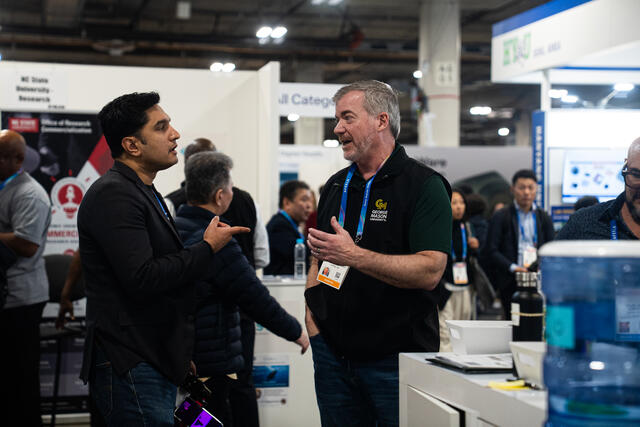
Earlier this year, I spent a week at the Consumer Electronics Show (CES), one of the largest technology gatherings in the world. For Mason Science, CES is not about spectacle—it is about situational awareness. It is about understanding where innovation is heading and how those trajectories will affect our students, our research, and our region.
Rather than watching someone speculate from a studio, I spoke directly with industry leaders, researchers, entrepreneurs, and policymakers—on the ground, in real time. I asked how technologies are evolving, where workforce needs are emerging, and what skills tomorrow’s graduates will require.
The result is always the same: I return energized, informed, and better positioned to strengthen our ecosystem of academic, government, and industry partners here in Northern Virginia and beyond.
Because insight only matters if it leads to action.
Our multidisciplinary structure allows us to translate what we learn into practice. We incorporate new ideas into curricula, expand experiential learning, and align research priorities with emerging needs. We work hard to keep our programs nimble in a rapidly changing landscape, particularly in technology-driven fields.
This work is deeply collaborative. Some of my most energizing moments as dean come from brainstorming with faculty and department chairs—thinking together about how new tools, methods, and discoveries can be embedded in classrooms, labs, field sites, and research centers.
Staying at the tip of the spear requires intentionality. It requires comfort with uncertainty. And it requires a shared commitment to continuous improvement—for our students and for society.
That same spirit is reflected in our engagement with George Mason’s Grand Challenge Initiative. Our faculty have embraced this framework with remarkable creativity and ambition, leading and participating in dozens of projects aligned with six solution areas.
Seventeen in-college proposals and eight collaborative submissions illustrate what is possible when we align around shared priorities. The quality of these efforts speaks to the strength of our faculty and to our collective commitment to advancing discovery, student success, and public impact.
We have also backed these ideas with real investment—mobilizing more than $8 million in internal and external support to accelerate the most promising initiatives.
This is what institutional leadership looks like: pairing vision with resources, and aspiration with execution.
As we look ahead, the College of Science remains fully committed to building new partnerships—through connections formed at CES, across the Washington, D.C. region we proudly call home, and with collaborators throughout the nation and around the world.
Our goal is clear: to set the pace for a new academic value proposition—one that integrates discovery, workforce development, student access, and societal relevance.
I can think of no better way to begin 2026.


