
Dean's Blog: Why Partnership Matters: Reflections from spaceNEXT 2026
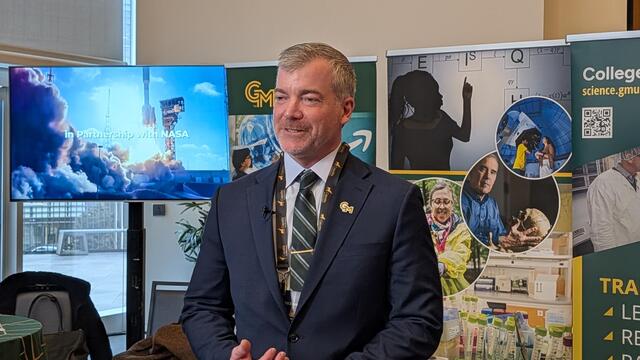
At the inaugural spaceNEXT 2026 convening in Tysons, Virginia — Connected DMV orchestrated a groundbreaking global forum bringing together 14 countries including leaders across industry, government, academia, and investment.
George Mason University served as the event’s lead academic partner. Stu Solomon, Connected DMV founder suggested, “Sustainable growth in space commerce depends not only on technologies and investment but (also) on cultivating talent ecosystems that connect universities, government, and industries across geographies.” Our participation in this event enabled attendees to better understand “how research institutions serve as engines of innovation, how academic partnerships accelerate commercialization, and why building a resilient talent pipeline is foundational to the next era of space activity.” he explained.
I offered an opening plenary address that cast a vision for how higher education institutions can serve as catalysts for innovation, workforce development, and economic growth in the emerging space economy.
Hopefully, my message was clear: the challenges and opportunities of our next frontier cannot be fully addressed in isolation. Whether tackling climate change from orbit, leading the NASA Landolt mission, enabling autonomous spacecraft, or training the next generation of scientists and engineers, success will depend on collaboration across sectors (and silos) — and that starts with strategic partnerships.
Space is no longer the exclusive domain of governments and space agencies. The space economy — encompassing satellite systems, Earth observation, space weather, automation, AI and quantum advancements, and in-space services — is rapidly commercializing and projected to reach trillions of dollars in value in the coming decades. With this growth comes increased demand for advanced research, nimble education pipelines, and novel approaches to technology transfer. George Mason University, and our college specifically, are uniquely positioned to bridge research insight with industry and policy needs.
Central to my remarks was the idea that partnerships fuel innovation. By joining forces with corporations, start-ups, government agencies, non-profits, and other universities, we have, and aim to continue to accelerate technologies that serve both space and Earth — from environmental monitoring and climate analytics to resilient communications infrastructures. These collaborations expand research horizons while anchoring real-world outcomes in scientific excellence.
Equally important is the role of partnerships in education and workforce development. I shared how George Mason’s signature cross-sector engagement creates pathways for students — placing them in internships, research teams, and interdisciplinary teams that reflect the ecosystem of the modern space economy. In an era where tomorrow’s workforce must be agile, tech-savvy, and globally competitive, partnerships ensure that academic programs remain relevant and responsive to market needs, ultimately producing graduates who are ready to lead in a collective success business.
Moreover, collaborative research initiatives — from joint labs to co-funded projects — amplify impact. They provide broader access to facilities, data, and expertise, while sharing risk and scaling innovation more effectively than any single organization could alone. Enabling this type of cooperation was at the heart of George Mason’s role as Lead Academic Partner for spaceNEXT, positioning the university at the nexus of conversations shaping national and global space strategies.
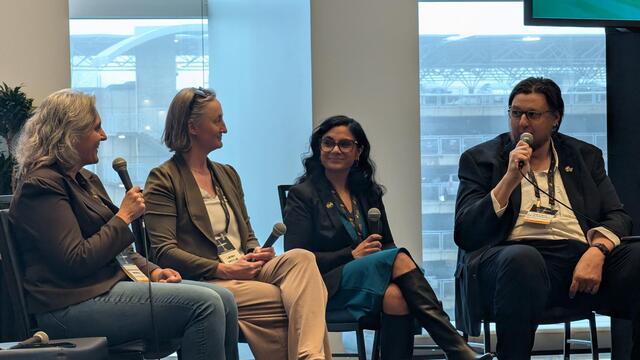
SpaceNEXT 2026 also featured a panel discussion including a cross section of our faculty from physics and astronomy, computational and data science, and mechanical engineering. I left that discussion feeling both inspired and grateful to be part of this community. Each brought such depth, authenticity, and care to their work and it showed throughout the conversation. We characterized our students’ grit, perseverance, and potential, a powerful reminder of why George Mason is such a special place.
I stand by my call to action: organizations of all types — whether corporate innovators, policy makers, research institutions, or non-profits — are invited to join in a shared mission to expand human knowledge, build economic value, and prepare future generations for the challenges ahead.
By partnering with George Mason’s College of Science, stakeholders gain access to world-class research, a pipeline of talent, and a community committed to impact — together turning ambitious dreams of space into Grand Challenge solutions with tangible benefits for society here on Earth.
I’ll keep you updated on our progress.
~ Cody


