
George Mason biosciences doctoral student turns setbacks into NIH research opportunity
Beginning a PhD is rarely straightforward. Beginning one just as the world shuts down adds an entirely new dimension to adaptability. For George Mason University Biosciences PhD student Matthew Lefkowitz, that quality would come to define his doctoral journey.
He entered the program in fall 2019 and had only just begun settling into graduate life when the COVID-19 pandemic brought research across the world to a halt. Laboratories closed, projects paused indefinitely, and traditional academic timelines dissolved almost overnight.
Rather than waiting for things to return to normal, he adapted.
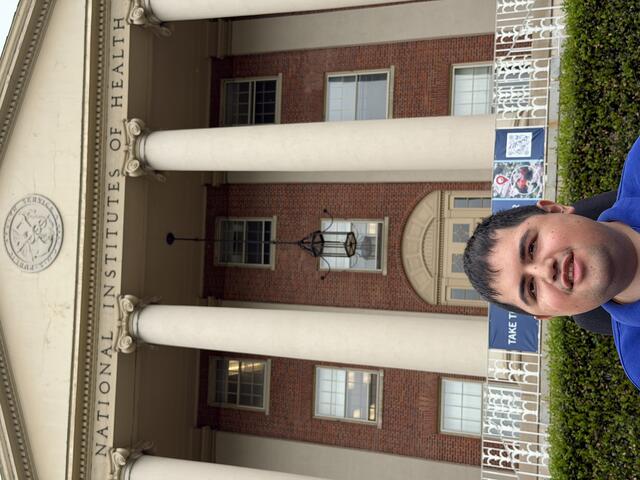
With laboratory access limited, Lefkowitz shifted his focus to coursework. Over the next two years, he completed 52 graduate credit hours. As the pandemic continued to disrupt traditional research pathways, George Mason supported him in pursuing external research opportunities. After months of persistence, he secured a position at the National Institutes of Health (NIH), becoming a pre-doctoral Intramural Research Training Award (IRTA) Fellow. There, he worked across two institutes: the National Institute of Neurological Disorders and Stroke (NINDS) and the National Center for Advancing Translational Sciences (NCATS).
The experience placed him in a highly interdisciplinary environment that brought together biology, computational science, and translational research—an ideal fit for his background.
“It combined problem-solving with the opportunity to work on challenges where there isn’t already a clear answer. That made it feel like a natural fit for my interests in math and science,” he said.
At the core of his doctoral work is the study of rare neuromuscular disorders, particularly congenital muscular dystrophy. Using artificial intelligence, machine learning, and deep learning, Lefkowitz’s research aims to better understand disease mechanisms and improve predictions of clinical outcomes, which is an especially complex challenge in the context of rare disease research.
While his interest in neuromuscular disease is informed, in part, by his own experience living with a rare neuromuscular disorder, he is equally motivated by the broader impact this work could have on improving diagnosis and care for patients facing similar conditions.
“The biggest challenge in the field right now is making sense of very small patient populations, which is often the case with rare diseases. When you’re working with such limited data, it becomes much harder to predict outcomes or draw reliable conclusions from what clinicians are observing.”
Before beginning his doctoral studies at George Mason, Lefkowitz applied to PhD programs nationwide. Despite strong academic credentials and a biomedical engineering degree from Virginia Tech, he faced widespread rejection.
The challenge, he said, stemmed from his training emphasis in mathematics, systems thinking, and problem-solving rather than extended wet-lab experience—skills that are highly valuable in interdisciplinary research. George Mason saw potential others overlooked.
“Mason didn’t just look at what I hadn’t done,” he said. “They saw the potential of what I could do.”
Since joining George Mason and later gaining experience at the NIH, Lefkowitz says he has grown significantly as both a researcher and an independent scientist.
“I grew in ways I couldn’t have imagined, especially in learning how to advocate for myself,” he said. “You have to take initiative and make those resources work for you. That meant learning to speak up, to position myself in the spaces where science is happening. That experience gave me a level of confidence I didn’t have before.”
Throughout his doctoral journey, mentorship has played a critical role. Lefkowitz credits School of Systems Biology faculty, including Ancha Baranova and Alessandra Luchini, as well as members of his doctoral committee, for providing guidance during pivotal moments.
“The difference was trust. Mason trusted me to figure things out and supported me while I did,” he said. “A PhD doesn’t teach you how to avoid challenges. It teaches you how to respond to them.”
Lefkowitz would like to thank the members of his dissertation committee, including his director and co-chair, Carsten G. Bönnemann, chief of the Neuromuscular and Neurogenetic Diseases of Childhood Section at NINDS; chair, Ancha Baranova; and committee members, Donald Lo, director of the Therapeutic Development Branch at NCATS; Alessandra Luchini; and Lance Liotta, professor at George Mason University.


