

Evaluation of a Novel High-Resolution Climate-Scale Simulation using the Model for Prediction Across Scales – Atmosphere (MPAS-A)
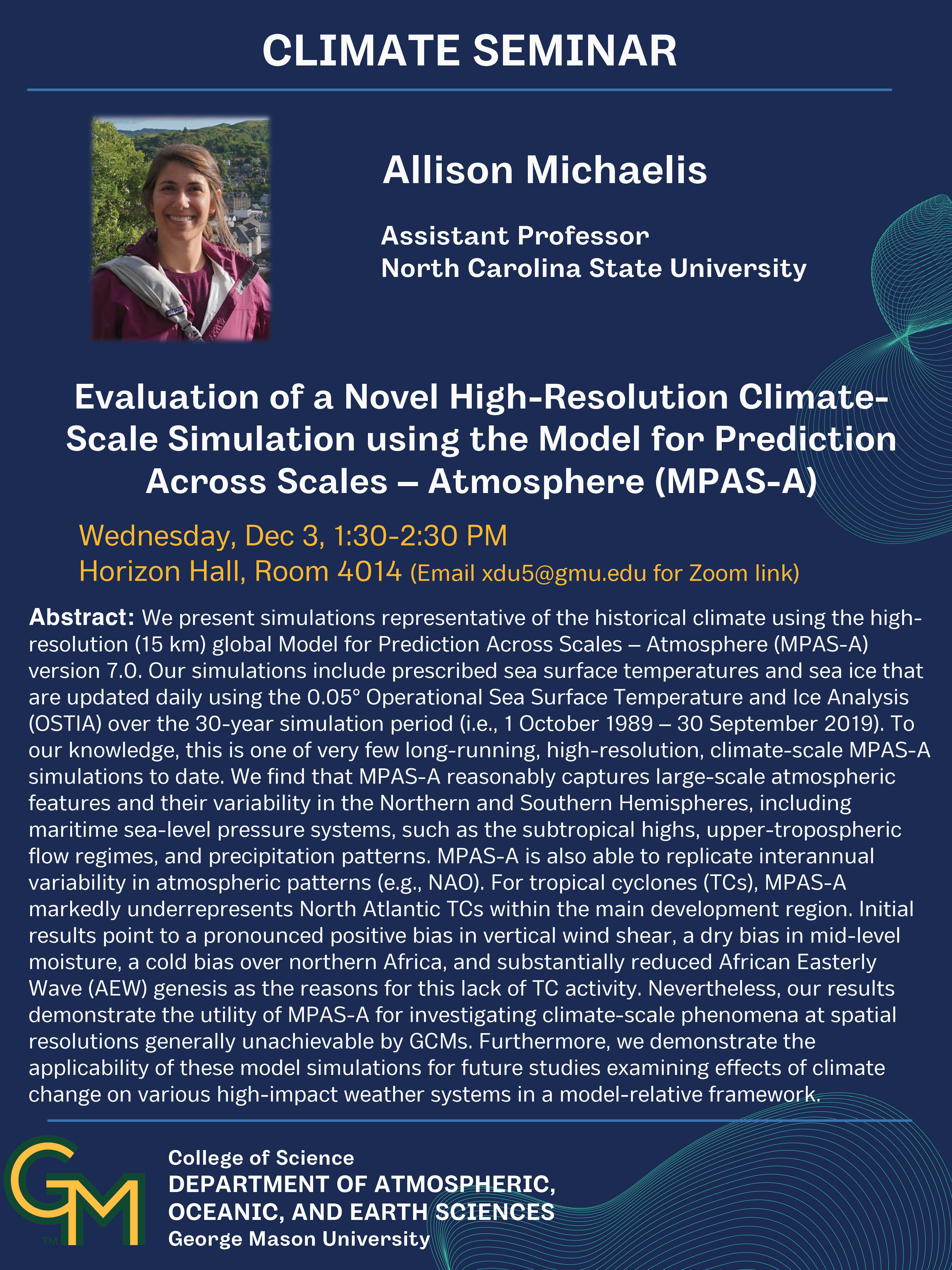
Speaker: Allison Michaelis, North Carolina State University
Title: Evaluation of a Novel High-Resolution Climate-Scale Simulation using the Model for Prediction Across Scales – Atmosphere (MPAS-A)
Host: Austin Reed
Time: Wed, 3 Dec, 1:30pm
Location: Horizon Hall, Room 4014 (Email xdu5@gmu.edu for Zoom link)
Abstract: We present simulations representative of the historical climate using the high-resolution (15 km) global Model for Prediction Across Scales – Atmosphere (MPAS-A) version 7.0. Our simulations include prescribed sea surface temperatures and sea ice that are updated daily using the 0.05° Operational Sea Surface Temperature and Ice Analysis (OSTIA) over the 30-year simulation period (i.e., 1 October 1989 – 30 September 2019). To our knowledge, this is one of very few long-running, high-resolution, climate-scale MPAS-A simulations to date. We find that MPAS-A reasonably captures large-scale atmospheric features and their variability in the Northern and Southern Hemispheres, including maritime sea-level pressure systems, such as the subtropical highs, upper-tropospheric flow regimes, and precipitation patterns. MPAS-A is also able to replicate interannual variability in atmospheric patterns (e.g., NAO). For tropical cyclones (TCs), MPAS-A markedly underrepresents North Atlantic TCs within the main development region. Initial results point to a pronounced positive bias in vertical wind shear, a dry bias in mid-level moisture, a cold bias over northern Africa, and substantially reduced African Easterly Wave (AEW) genesis as the reasons for this lack of TC activity. Nevertheless, our results demonstrate the utility of MPAS-A for investigating climate-scale phenomena at spatial resolutions generally unachievable by GCMs. Furthermore, we demonstrate the applicability of these model simulations for future studies examining effects of climate change on various high-impact weather systems in a model-relative framework.


