
Faculty philanthropy fuels quantum innovation with $3 million gift
An endowed professorship will help educate and inspire the next generation of quantum scientists.
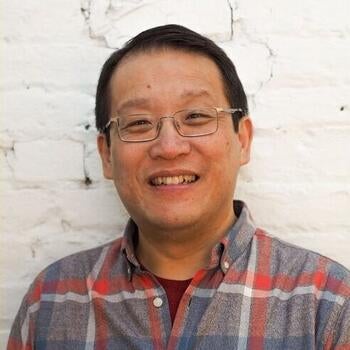
Quantum science is a revolution in the making, and a recent donation by Department of Physics and Astronomy Professor Paul So has placed George Mason University at the forefront of understanding and harnessing its capabilities.
Through a generous gift from So’s SYYK Foundation, George Mason’s College of Science will be able to advance the education of the next generation of quantum scientists: a gift of $3 million will establish an endowed professorship within the Department of Physics and Astronomy. The university seeks an esteemed faculty member to fill this role, with a preference for a scientist who has expertise in quantum sciences, “someone with new ideas,” said So, “who will create a vibrant space in the department.”
“It’s important to think about quantum as a revolutionary and game-changing leap ahead in our ability to compute, to sense the world around us, and to communicate with each other,” said Patrick Vora, associate professor in the Department of Physics and Astronomy, and director of George Mason’s Quantum Science and Engineering Center.
The goal of the professorship is to build a community of learning around quantum technology, said Vora. “It will catalyze new collaborations between faculty members, but always, at the end of the day, our biggest impact is going to be in training our students.”
Quantum mechanics describes the behavior of subatomic particles and their properties. Understanding and controlling those properties could drive significant advances in engineering and technology, Vora explained.
“Your phone runs on quantum science, your computer runs on quantum science,” So added. “New materials, new technologies, and new applications will all rely on quantum.” Potentially among them—enhanced weather prediction as well as faster drug discovery and development.
So founded SYYK with his brother Peter, a professor of mechanical and biological engineering at MIT, to continue their mother’s philanthropic efforts after her death in 2021. The charitable nonprofit has a broad mission but prioritizes gifts to educational and cultural institutions.
“Even when we were growing up in Hong Kong, my parents supported local schools,” So said. “They appreciated that education was the foundation of a kid’s future, the foundation of society’s future.” He believes that strengthening the quantum science program at George Mason will attract top students to the university and encourage more cross-pollination between disciplines like math, computer science, and engineering.
“One of the biggest challenges of realizing quantum technology is less about the ‘quantum’ and more the people,” Vora said. “Developing the science into an industry will require a significant expansion of the workforce. The only way that you can do that is by expanding representation in the workforce. And there are few things that George Mason does as well as providing opportunity for people who may not have had it before.”
So is optimistic that the investment in quantum will better position students to take advantage of the unique opportunity George Mason offers. “We’re right here in the Capital region, near so many tech companies,” he said, “and there’s a lot of support from the government to develop quantum.”
Indeed, the government recently announced that it would inject $2 billion into quantum development, funding nine domestic computer companies to build quantum infrastructure. The White House, meanwhile, also issued executive orders to accelerate the migration of federal computing systems to systems that can protect them from quantum cyber-attacks. Quantum-related job postings have tripled in the last 15 years with an average salary of $131 thousand.
The structure of the new professorship is a novel one at George Mason. The professor’s salary will be covered by the College of Science, while proceeds from the endowment will serve as discretionary funding to support graduate students. The donation also includes a percentage of the gift applied as “current use” funds, available now to provide support while the endowment yield grows.
“Paul So’s extraordinary generosity gives George Mason the ability to move with both urgency and ambition in quantum science,” said Cody W. Edwards, dean of the College of Science. “This endowed professorship will help us recruit a field-shaping scholar, support graduate students, and accelerate the collaborations needed to prepare the next generation of quantum scientists and innovators. It is a gift with immediate impact, long-term vision, and profound significance for the College of Science, George Mason, and the Commonwealth.”
Given the surge in quantum investment and jobs around the country, So hopes the gift will encourage additional giving to support quantum at George Mason University. “Compared to what is needed, this is just the start,” he said.
“We’re talking about a generation-scale technological shift,” said Vora. “Bringing on this new faculty member, around which our current and future faculty members can collaborate and coalesce, will really change what it looks like to be a quantum scientist in the future.”

Advancing Virginia’s Quantum Future
As George Mason University’s Grand Challenge Initiative enters its second year, the College of Science is leading and collaborating on five of the seven newly funded catalyst projects, including George Mason’s Quantum Leap, led by Vora. The initiative brings together partners across academia, industry, and government to advance quantum research, expand educational opportunities, and position Virginia as a leader in quantum technology. It also aligns with the university’s newly announced Master of Science in Quantum Science and Engineering, the first program of its kind in Virginia and one of only a handful in the United States.


