
George Mason COVES Fellow builds transparent AI system to identify potential career pathways
Artificial intelligence (AI) is reshaping the modern world, from automating routine tasks to informing decisions. Yet understanding how AI systems reach their conclusions remain murky, raising a fundamental question for policymakers, educators, and users alike: how much can we trust systems we cannot fully explain? One George Mason University mathematics student is working to address that challenge by combining classical mathematical theory with modern AI techniques to build models that are both scalable and transparent.
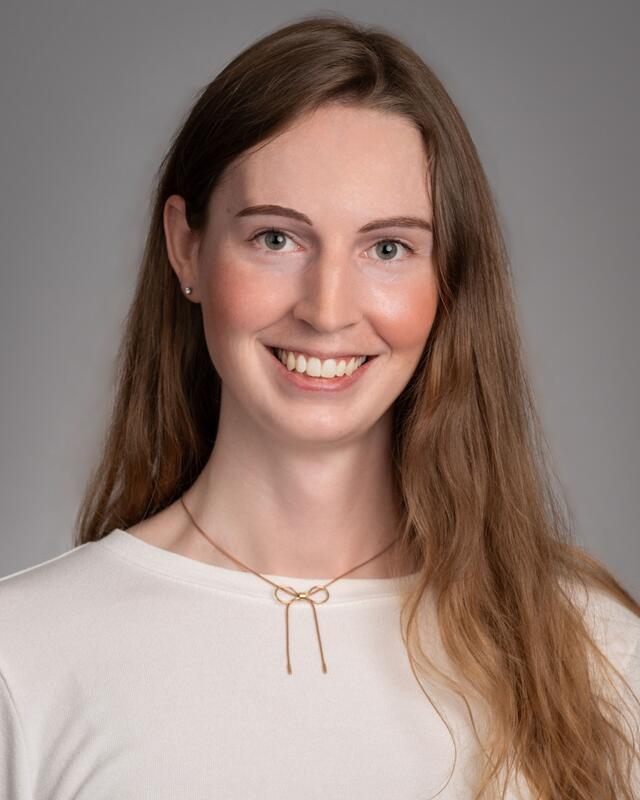
Mathematical Sciences PhD candidate Jeanie Schreiber, BS Mathematics ’20, earned the prestigious Commonwealth of Virginia Engineering and Science (COVES) Policy Fellowship in 2025, where she applied this research focus in a real-world policy setting. Working with the State Council of Higher Education for Virginia (SCHEV) last summer, she helped develop a career pathways recommendation engine as part of SCHEV’s student outcomes initiative. The tool allows users to input specific interests, skills, and parameters, then identifies potential career paths aligned with those inputs.
As part of SCHEV’s policy research team, Schreiber explored natural language processing (NLP) methods like those behind tools like ChatGPT. Her goal was to build the theoretical framework and algorithms for the tool from large occupational data sets, focusing on making the model’s decisions clear and interpretable.
“A lot of AI methods can sometimes produce unexpected or inconsistent answers, so the goal was to minimize that as much as possible,” Schreiber said. “Much of my work focused on researching ways to make models more explainable through principled design choices and access to richer data sources."
Her role also afforded her access to several conferences and engagement with state legislatures and industry leaders.
“I had the opportunity to participate in policy meetings, and it was fascinating to see how decisions come together. There are many moving parts involved in addressing complex issues,” she said. “It was cool to see how people with different areas of expertise contributed in unique ways and how my own expertise could be applied to something tangible.”
Schreiber said one of the biggest things she learned was to not underestimate the value of her own expertise or assume it would go unnoticed.
“Your voice matters, especially when speaking on your area of expertise. People will listen,” she said. “I also learned to take full advantage of every learning opportunity. Conferences and team meetings are important because you get to meet so many different people and build connections.”
A lifelong resident of Fairfax, Schreiber enrolled at George Mason University as a mathematics undergraduate. Her experience in the Mason Experiential Geometry Lab introduced her to mathematical research early in her academic career and inspired her to pursue graduate studies.
As a graduate student, she participated in a National Science Foundation Graduate Research Fellowship, where she developed machine learning methods to analyze images and signals in materials science with both accuracy and interpretability. Her work drew on techniques such as topological data analysis to uncover and explain underlying patterns in complex data, going beyond simple classification. She also earned two “Excellence in Research” awards from George Mason’s Center for Mathematics and Artificial Intelligence in 2021 and 2025.
Schreiber will continue researching how to make traditional, interpretable mathematical methods scalable to massive modern datasets, with the goal of combining them with AI-level performance. This includes uncovering the underlying geometry of high-dimensional data to improve understanding, clarity, and the ability to connect models to real scientific outcomes.


