

2 Sep (CLIM) - Lee, Precipitation in SPEAR model Seminar
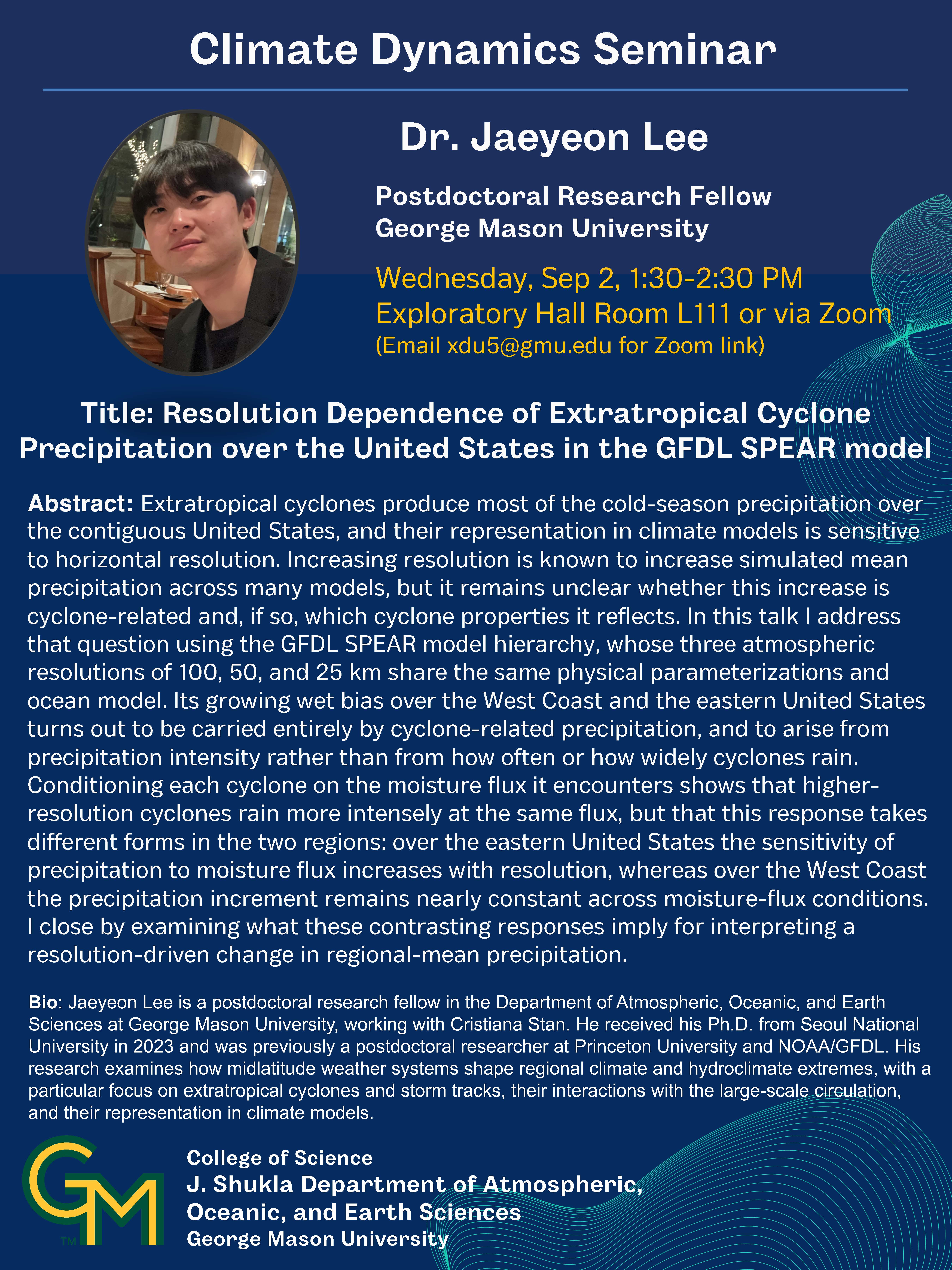
Speaker: Jaeyeon Lee, George Mason University
Title: Resolution Dependence of Extratropical Cyclone Precipitation over the United States in the GFDL SPEAR model
Time: Wednesday, September 2, 2026, 1:30–2:30 pm
Location: Exploratory Hall Room L111 or via Zoom
Zoom:https://gmu.zoom.us/j/91217571990?pwd=vBsLKesG4bq7oW1LKZNRmPhh3XVp4k.1 (Passcode: CLIMATE)
Abstract: Extratropical cyclones produce most of the cold-season precipitation over the contiguous United States, and their representation in climate models is sensitive to horizontal resolution. Increasing resolution is known to increase simulated mean precipitation across many models, but it remains unclear whether this increase is cyclone-related and, if so, which cyclone properties it reflects. In this talk I address that question using the GFDL SPEAR model hierarchy, whose three atmospheric resolutions of 100, 50, and 25 km share the same physical parameterizations and ocean model. Its growing wet bias over the West Coast and the eastern United States turns out to be carried entirely by cyclone-related precipitation, and to arise from precipitation intensity rather than from how often or how widely cyclones rain. Conditioning each cyclone on the moisture flux it encounters shows that higher-resolution cyclones rain more intensely at the same flux, but that this response takes different forms in the two regions: over the eastern United States the sensitivity of precipitation to moisture flux increases with resolution, whereas over the West Coast the precipitation increment remains nearly constant across moisture-flux conditions. I close by examining what these contrasting responses imply for interpreting a resolution-driven change in regional-mean precipitation.
Bio:Jaeyeon Lee is a postdoctoral research fellow in the Department of Atmospheric, Oceanic, and Earth Sciences at George Mason University, working with Cristiana Stan. He received his Ph.D. from Seoul National University in 2023 and was previously a postdoctoral researcher at Princeton University and NOAA/GFDL. His research examines how midlatitude weather systems shape regional climate and hydroclimate extremes, with a particular focus on extratropical cyclones and storm tracks, their interactions with the large-scale circulation, and their representation in climate models.


