

This course turns climate science into real-world impact for Virginia communities
What difference does a tree make? That’s what George Mason University researcher Luis Ortiz wanted to find out—before it was planted. Cities increasingly experience extreme heat that poses danger to anyone outside. The urban environment, even on a very small scale, can either help alleviate the problem or make it vastly worse.
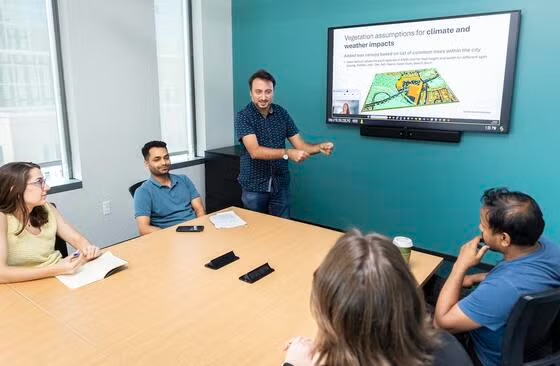
“We teach students the fundamentals of how the broader weather interacts with very, very local aspects of the built environment,” said Ortiz, who teaches in George Mason’s J. Shukla Department of Atmospheric, Oceanic, and Earth Sciences. “By very, very local, I mean, what happens if I put a certain tree in one location, or if I apply a coating to a building’s surface to reflect the sun.”
Ortiz’s course, CLIM 759 Micrometeorological Modeling for Local Climate Action, targets “hyperlocal” community needs. It’s a way of taking research out of the lab and into the real world where it can have immediate impact. Ortiz and other professors—in collaboration with George Mason’s Institute for a Sustainable Earth—piloted a model to create classes that work almost like nonprofit start-ups with municipalities and neighborhood groups as clients.
“We are meeting communities where they are and figuring out what their needs are related to weather hazards on heat, flooding, and air pollution. This is all based on the extensive community engagement that we've been doing with the Virginia Climate Center,” said Ortiz, who is the codirector of the VCC.
This is the second year that Ortiz is offering the graduate-level class, which is open to every major. The students work individually with community groups to study their needs and model the outcomes of various interventions. Last year, students worked with South Side ReLeaf in Richmond to model extreme heat zones around schools and shopping centers. This year, they ran individual projects with the cities of Fairfax, Alexandria, and Arlington, as well as Groundwork USA. These stakeholders were all invited to a day of final presentations at the end of the semester.
“The students are learning urban microclimate physics, as well as the software and models needed to understand them and answer real-world questions,” said Ortiz.
The course is truly interdisciplinary, attracting students majoring in fields from across the university, including GIS, civil engineering, mathematics, and fluid dynamics. They use social science methods to determine the communities’ needs.
Ivy Stempkovski, a climate dynamics PhD student who helped develop the course and is now taking it, created models to evaluate how public water features, such as splash parks, help kids cool down.
“My peers are thinking of things that never would have crossed my radar,” said Stempkovski. “That’s important because the whole goal is to make sure that we're maximizing impact for our community partner and the community themselves. If it weren't for the different perspectives, I think we could risk falling short. For instance, the engineers take a more practical perspective, and the GIS students know more about zoning laws.”
Gavin Middleton, a PhD student in earth and geoinformation sciences, took the course in its first year. His models revealed startling facts about how a lack of green spaces increased citizens’ susceptibility to heat stroke.
“The area I was looking at was an elementary school,” said Middleton. “This school was right next to a six-lane road that had no trees. We found that if kids were walking down that road in the middle of the summer heat, there was about a 5 percent chance that you got a heat stroke on any one kid.”
Other projects showed high risks of heat stroke and asthma attacks around unshaded shopping complexes with large parking lots, as well as bus stops where people would have to wait for long periods with no relief.
“I would say that it was a very important experience to actually get to know the people that my science affected,” said Middleton. “It's definitely not something you see at every university.”
Ortiz built the course as part of his work at the VCC and based it on the lean start-up model for businesses.
"Our students are both learning state-of-the-art modeling techniques and using them to answer important questions for stakeholders in the commonwealth and beyond,” he said. “With this model, students work on real-world problems, and our partners get access to science-backed data and insights to help them build stronger, more resilient communities.”


