

Sustainability in action: How George Mason students use art to communicate environmental solutions
Sustainability education has long combined science, policy, fieldwork, and community engagement. George Mason University's EVPP 480: Sustainability in Action builds on that foundation by introducing an unexpected partner: art.

EVPP 480: Sustainability in Action is an interdisciplinary course that brings together students from environmental science, environmental and sustainability studies, business, and other disciplines to explore how individuals and communities can advance sustainability solutions. Environmental Science and Policy Assistant Professor Jennifer Sklarew teaches one section of the course, which connects sustainability theory with real-world practice through experiential learning, service projects, and public outreach.
One project from this past spring challenged students to communicate sustainability concepts through visual storytelling using felt artwork inspired by the United Nations Sustainable Development Goals (SDGs).
"The goal was to have the students explore how to use art to express sustainability, but then also to educate other people about the Sustainable Development Goals," Sklarew said.
The course's art component emerged from Sklarew's belief that sustainability education should include multiple ways of understanding and communicating complex issues.
"Many students either don't make a connection to art, or they don't realize they could incorporate it into their representation of sustainability," she said.

Sklarew said the project reflects a STEAM education approach that integrates the arts with science, technology, engineering, and mathematics to help students engage with complex topics from multiple perspectives and communicate their ideas in creative ways.
The idea for the project emerged after Sklarew encountered a wet-felting artist whose work centered on social justice and sustainability during a museum visit over Martin Luther King Jr. Day weekend. Inspired by the experience, she secured a Mason Impact micro-grant to bring award-winning fiber artist Felicia Reed to campus to lead a felting workshop for EVPP 480 students.
The workshop, which Sklarew titled Sustainability through Art: Visualizing the Sustainable Development Goals, introduced students to the felting process while exploring the sustainability of the materials and the role of art in communicating environmental and social issues. Sklarew then asked the students to select one or more Sustainable Development Goals that resonated with them and translate those concepts into visual art. The project challenged them to distill complex environmental and social issues into accessible visual narratives.

The resulting artworks demonstrated both creativity and a deep understanding of the connections between sustainability issues. Some students connected multiple sustainability goals within a single piece. Another linked life on land and life below water, highlighting the interconnectedness of ecosystems. One piece examined the environmental impacts of data centers, weaving together concerns related to energy consumption, water use, and pollution. Other projects explored themes such as bird conservation, environmental stewardship, and community resilience.
Sklarew asked the students to write artist statements explaining the sustainability concepts behind their work, encouraging viewers to reflect more deeply on the issues represented. For her, the project revealed levels of insight and engagement that traditional assignments might not have uncovered.
"Expressing sustainability through art creates connections with people who might not otherwise connect with these sustainability concepts,” she said.
Rather than exhibiting the projects in a traditional gallery setting, Sklarew worked with Mason Exhibitions Program Manager Yassmin Salem and George Mason's campus librarians to display the artwork in Fenwick Library. During Earth Month, students, faculty, staff, and visitors could encounter the artwork as part of their everyday routines, creating opportunities for unexpected engagement with sustainability concepts. Sklarew viewed the library as the ideal venue.
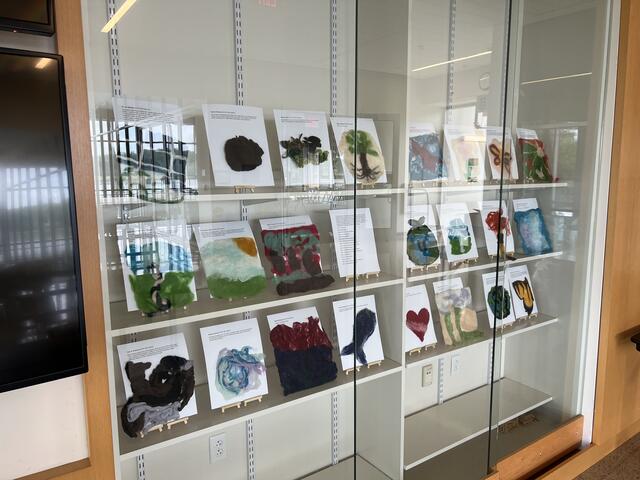
"People already come there to learn," she said. "The exhibit offers an opportunity for individuals who might never attend an environmental lecture or an art show to engage with sustainability concepts in an accessible way."
Throughout the semester, students participated in experiential service-learning activities that illustrated sustainability in action. Past course experiences include kayak and trail-based cleanups at Occoquan Regional Park, farming and food justice initiatives at Arcadia Farm, and team-led projects contributing to the UN Sustainable Development Goals at the local level. These activities help students see sustainability not as an abstract concept, but as an active practice that requires engagement and action.
By creating artwork inspired by the Sustainable Development Goals, students explored new ways to communicate sustainability concepts and share them with the campus community. The exhibit demonstrated how art can make complex issues more accessible and engaging.


