Skip to main
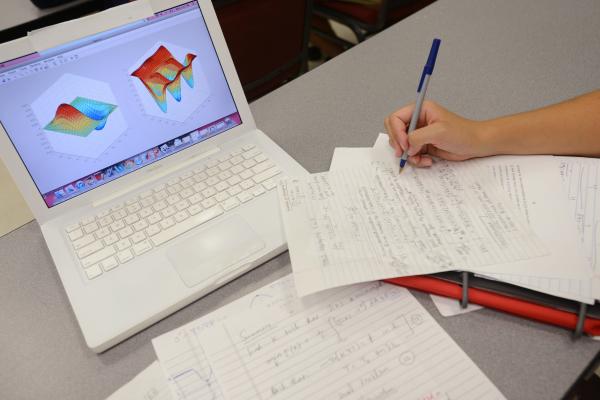
Math equations

Learn at a mathematical powerhouse. We offer strong and flexible programs at all degree levels.

Students majoring in mathematics take courses in the logical foundations of mathematics, the calculus sequence, matrix algebra, and discrete mathematics. Majors choose from a concentration of applied, traditional, or actuarial mathematics. Both the BA and the BS in mathematics allow entry to advanced studies or career opportunities as diverse as the fields to which mathematics is applied. The metro region of Washington, D.C. provides a particularly fertile area for related job opportunities, including consulting, teaching, and government.

Mason offers a vibrant graduate mathematics program that awards MS and PhD degrees. The program provides exciting opportunities for students interested in studying advanced mathematics and conducting independent research. Students can specialize in a diverse selection of areas in pure, applied and computational mathematics.

Students use well-developed mathematical skills across multiple fields. 

Mason offers a vibrant graduate mathematics program that awards MS and PhD degrees. Students can specialize in a diverse selection of areas in pure, applied and computational mathematics.

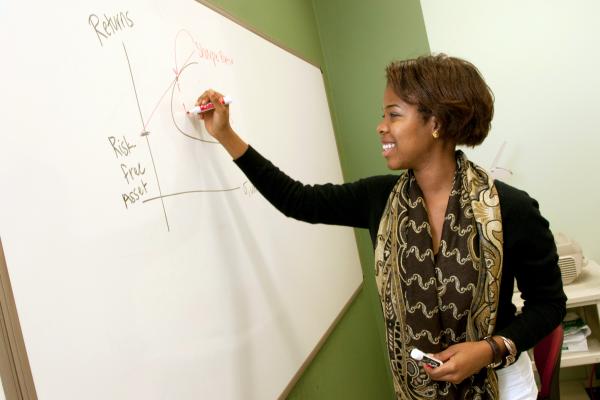
Mathematics student

Be a part of our mathematical community.

Use 3D printing technology to present mathematical concepts as concrete physical objects at our Math Maker Lab

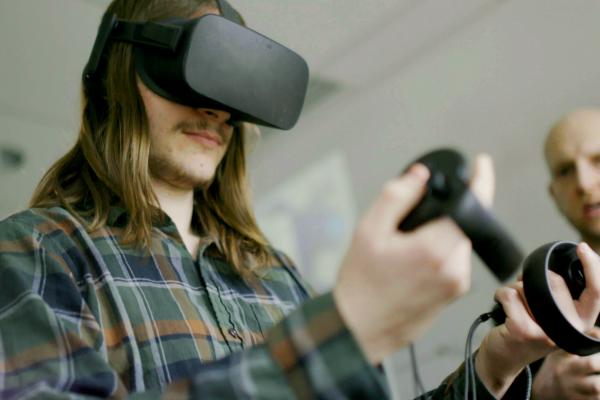
Check out the Mason Experimental Geometry Lab (MEGL) to think deeper and go further and take your mathematical curiosity to the next level.


A MEGL student uses a VR headset

News and Events

Upcoming Events

More Events
Apr 24

Analysis Seminar: Dynamical Frames and Hyperinvariant Subspaces

Apr 24, 2026, 11:30 AM - 12:30 PM

Speaker: Victor Bailey, University of Oklahoma Title: Dynamical Frames and Hyperinvariant Subspaces Abstract: The theory of dynamical frames arose from practical problems in dynamical sampling where the initial state of a vector needs to be recovered from the space-time samples of future states of the vector. This leads to the
Apr 24

Applied & Computational Mathematics seminar: Modeling of DNA origami electrochemical signaling for optimal biosensor design

Apr 24, 2026, 1:30 - 2:30 PM

Speaker: Alli Carson, National Institute of Standards and Technology Title: Modeling of DNA origami electrochemical signaling for optimal biosensor design Abstract: Biological field effect transistors (Bio-FETs) have shown great promise in revolutionizing diagnostic testing, enabling the development of inexpensive and portable biosensors with a very low limit of detection that
Apr 24

Topology, Algebraic Geometry, and Dynamics Seminar (TADS): Classical aspects of self-correcting quantum memories

Apr 24, 2026, 1:30 - 2:30 PM

Speaker: Adam Artymowicz, University of Maryland Title: Classical aspects of self-correcting quantum memories Abstract: One of the main challenges in the development of quantum computers is the inherent sensitivity of quantum information to noise. To mitigate this, it is widely accepted that some kind of error correction scheme is necessary

Latest News

More news

Why the Math department at Mason?

15,000

Number of students the department teaches each year.

65

Currently 65 MA and PhD students

12 plus

Undergraduate majors participate in dozens of research projects and win awards at national and international conferences.

Locations

Visit Us On Campus

Come visit the Math department at George Mason University.

Fairfax Campus, Exploratory Hall 4400
4400 University Drive, MSN 3F2, Fairfax, VA 22030
Phone: 703-993-1460
 

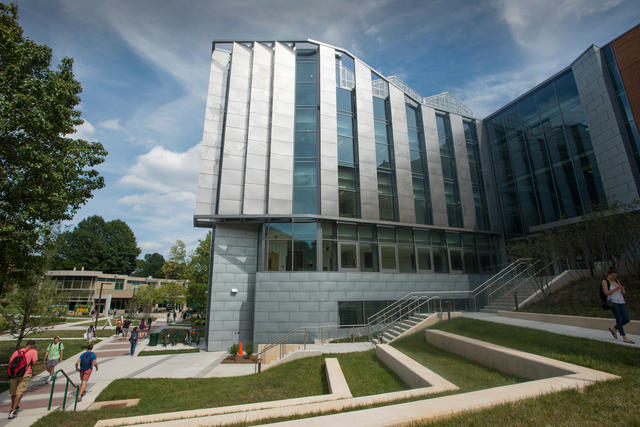
Exploratory Hall at George Mason University Fairfax Campus

* The programs and services offered by George Mason University are open to all who seek them. George Mason does not discriminate on the basis of race, color, religion, ethnic national origin (including shared ancestry and/or ethnic characteristics), sex, disability, military status (including veteran status), sexual orientation, gender identity, gender expression, age, marital status, pregnancy status, genetic information, or any other characteristic protected by law. After an initial review of its policies and practices, the university affirms its commitment to meet all federal mandates as articulated in federal law, as well as recent executive orders and federal agency directives.